MoreExam
1. Question Content...
EXPLANATION
Answer: X - EXPLANATION Content.
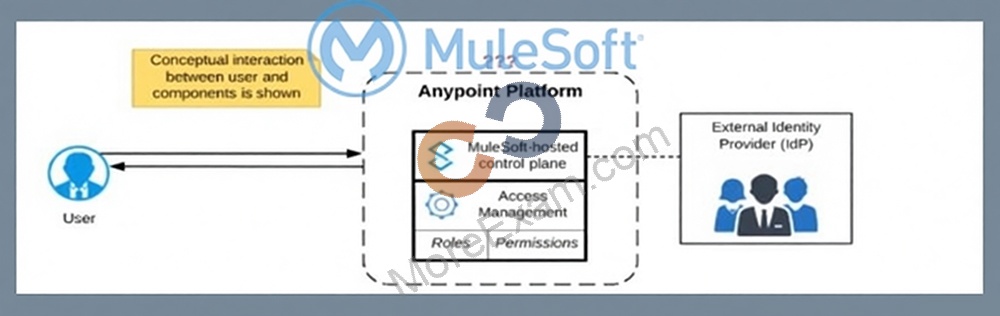
Question1: Refer to the exhibit.Anypoint Platform supports role-based access control (RBAC) to features of the platform. An organization has configured an external Identity Provider for identity management with Anypoint Platform.What aspects of RBAC must ALWAYS be controlled from the Anypoint Platform control plane and CANNOT be controlled via the external Identity Provider?
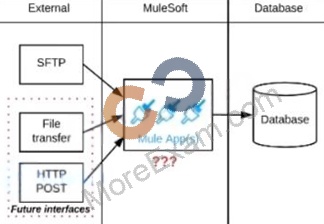
Question2: Refer to the exhibit.A business process involves the receipt of a file from an external vendor over SFTP. The file needs to be parsed and its content processed, validated, and ultimately persisted to a database. The delivery mechanism is expected to change in the future as more vendors send similar files using other mechanisms such as file transfer or HTTP POST.What is the most effective way to design for these requirements in order to minimize the impact of future change?
Question3: Refer to the exhibit. An organization is designing a Mule application to receive data from one external business partner. The two companies currently have no shared IT infrastructure and do not want to establish one. Instead, all communication should be over the public internet (with no VPN).What Anypoint Connector can be used in the organization's Mule application to securely receive data from this external business partner?
Question4: An external REST client periodically sends an array of records in a single POST request to a Mule application API endpoint.The Mule application must validate each record of the request against a JSON schema before sending it to a downstream system in the same order that it was received in the array Record processing will take place inside a router or scope that calls a child flow. The child flow has its own error handling defined. Any validation or communication failures should not prevent further processing of the remaining records.To best address these requirements what is the most idiomatic(used for it intended purpose) router or scope to used in the parent flow, and what type of error handler should be used in the child flow?
Question5: An organization is evaluating using the CloudHub shared Load Balancer (SLB) vs creating a CloudHub dedicated load balancer (DLB). They are evaluating how this choice affects the various types of certificates used by CloudHub deplpoyed Mule applications, including MuleSoft-provided, customer-provided, or Mule application-provided certificates.What type of restrictions exist on the types of certificates that can be exposed by the CloudHub Shared Load Balancer (SLB) to external web clients over the public internet?
Question6: A global organization operates datacenters in many countries. There are private network links between these datacenters because all business data (but NOT metadata) must be exchanged over these private network connections.The organization does not currently use AWS in any way.The strategic decision has Just been made to rigorously minimize IT operations effort and investment going forward.What combination of deployment options of the Anypoint Platform control plane and runtime plane(s) best serves this organization at the start of this strategic journey?
Question7: An Order microservice and a Fulfillment microservice are being designed to communicate with their dients through message-based integration (and NOT through API invocations).The Order microservice publishes an Order message (a kind of command message) containing the details of an order to be fulfilled. The intention is that Order messages are only consumed by one Mute application, the Fulfillment microservice.The Fulfilment microservice consumes Order messages, fulfills the order described therein, and then publishes an OrderFulfilted message (a kind of event message). Each OrderFulfilted message can be consumed by any interested Mule application, and the Order microservice is one such Mute application.What is the most appropriate choice of message broker(s) and message destination(s) in this scenario?
Question8: What Anypoint Connectors support transactions?
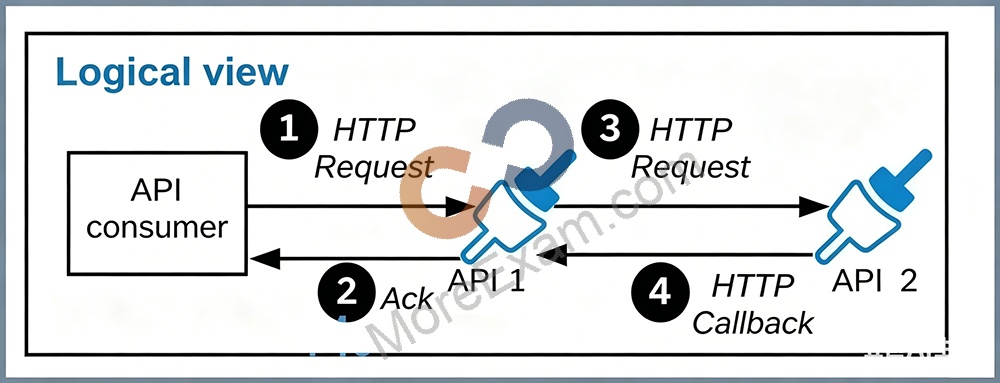
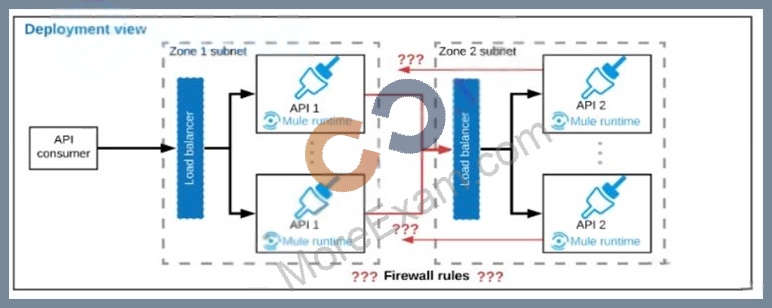
Question9: Refer to the exhibit.A business process involves two APIs that interact with each other asynchronously over HTTP. Each API is implemented as a Mule application. API 1 receives the initial HTTP request and invokes API 2 (in a fire and forget fashion) while API 2, upon completion of the processing, calls back into API l to notify about completion of the asynchronous process.Each API Is deployed to multiple redundant Mule runtimes and a separate load balancer, and is deployed to a separate network zone.In the network architecture, how must the firewall rules be configured to enable the above Interaction between API 1 and API 2?
Question10: A Mule application is being designed To receive nightly a CSV file containing millions of records from an external vendor over SFTP, The records from the file need to be validated, transformed. And then written to a database. Records can be inserted into the database in any order.In this use case, what combination of Mule components provides the most effective and performant way to write these records to the database?
Question11: Anypoint Exchange is required to maintain the source code of some of the assets committed to it, such as Connectors, Templates, and API specifications.What is the best way to use an organization's source-code management (SCM) system in this context?
Question12: Mule applications need to be deployed to CloudHub so they can access on-premises database systems. These systems store sensitive and hence tightly protected data, so are not accessible over the internet.What network architecture supports this requirement?
Question13: An API has been unit tested and is ready for integration testing. The API is governed by a Client ID Enforcement policy in all environments.What must the testing team do before they can start integration testing the API in the Staging environment?
Question14: A retailer is designing a data exchange interface to be used by its suppliers. The interface must support secure communication over the public internet. The interface must also work with a wide variety of programming languages and IT systems used by suppliers.What are suitable interface technologies for this data exchange that are secure, cross-platform, and internet friendly, assuming that Anypoint Connectors exist for these interface technologies?
Question15: An organization is designing the following two Mule applications that must share data via a common persistent object store instance:- Mule application P will be deployed within their on-premises datacenter.- Mule application C will run on CloudHub in an Anypoint VPC.The object store implementation used by CloudHub is the Anypoint Object Store v2 (OSv2).what type of object store(s) should be used, and what design gives both Mule applications access to the same object store instance?
Question16: An organization's security policies mandate complete control of the login credentials used to log in to Anypoint Platform. What feature of Anypoint Platform should be used to meet this requirement?
Question17: A Mule application is being designed to do the following:Step 1: Read a SalesOrder message from a JMS queue, where each SalesOrder consists of a header and a list of SalesOrderLineltems.Step 2: Insert the SalesOrder header and each SalesOrderLineltem into different tables in an RDBMS.Step 3: Insert the SalesOrder header and the sum of the prices of all its SalesOrderLineltems into a table In a different RDBMS.No SalesOrder message can be lost and the consistency of all SalesOrder-related information in both RDBMSs must be ensured at all times.What design choice (including choice of transactions) and order of steps addresses these requirements?
Question18: A mule application is deployed to a Single Cloudhub worker and the public URL appears in Runtime Manager as the APP URL.Requests are sent by external web clients over the public internet to the mule application App url. Each of these requests routed to the HTTPS Listener event source of the running Mule application.Later, the DevOps team edits some properties of this running Mule application in Runtime Manager.Immediately after the new property values are applied in runtime manager, how is the current Mule application deployment affected and how will future web client requests to the Mule application be handled?
Question19: A Mule application currently writes to twoseparate SQL Server database instances across the internet using a single XA transaction. It is 58. proposed to split this one transaction into two separate non-XA transactions with no other changes to the Mule application.What non-functional requirement can be expected to be negatively affected when implementing this change?
Question20: A mule application uses an HTTP request operation to involve an external API.The external API follows the HTTP specification for proper status code usage.What is possible cause when a 3xx status code is returned to the HTTP Request operation from the external API?
Question21: What requires configuration of both a key store and a trust store for an HTTP Listener?
Question22: What metrics about API invocations are available for visualization in custom charts using Anypoint Analytics?
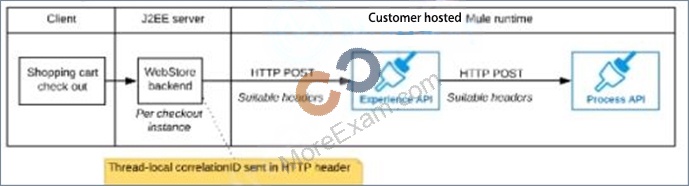
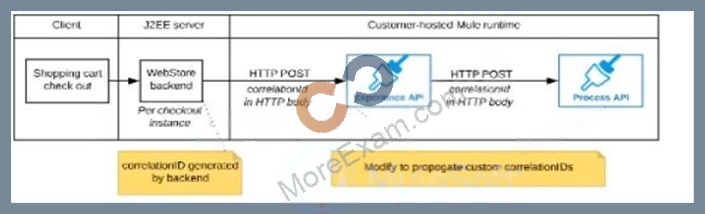
Question23: Refer to the exhibit.A shopping cart checkout process consists of a web store backend sending a sequence of API invocations to an Experience API, which in turn invokes a Process API. All API invocations are over HTTPS POST. The Java web store backend executes in a Java EE application server, while all API implementations are Mule applications executing in a customer -hosted Mule runtime.End-to-end correlation of all HTTP requests and responses belonging to each individual checkout Instance is required. This is to be done through a common correlation ID, so that all log entries written by the web store backend, Experience API implementation, and Process API implementation include the same correlation ID for all requests and responses belonging to the same checkout instance.What is the most efficient way (using the least amount of custom coding or configuration) for the web store backend and the implementations of the Experience API and Process API to participate in end-to-end correlation of the API invocations for each checkout instance?A)The web store backend, being a Java EE application, automatically makes use of the thread-local correlation ID generated by the Java EE application server and automatically transmits that to the Experience API using HTTP-standard headers No special code or configuration is included in the web store backend, Experience API, and Process API implementations to generate and manage the correlation IDB)The web store backend generates a new correlation ID value at the start of checkout and sets it on the X-CORRELATlON-lt HTTP request header In each API invocation belonging to that checkout No special code or configuration is included in the Experience API and Process API implementations to generate and manage the correlation IDC)The Experience API implementation generates a correlation ID for each incoming HTTP request and passes it to the web store backend in the HTTP response, which includes it in all subsequent API invocations to the Experience API.The Experience API implementation must be coded to also propagate the correlation ID to the Process API in a suitable HTTP request headerD)The web store backend sends a correlation ID value in the HTTP request body In the way required by the Experience API The Experience API and Process API implementations must be coded to receive the custom correlation ID In the HTTP requests and propagate It in suitable HTTP request headers
Question24: What is required before an API implemented using the components of Anypoint Platform can be managed and governed (by applying API policies) on Anypoint Platform?
Question25: An organization is sizing an Anypoint VPC to extend their internal network to Cloudhub.For this sizing calculation, the organization assumes 150 Mule applications will be deployed among three(3) production environments and will use Cloudhub's default zero-downtime feature. Each Mule application is expected to be configured with two(2) Cloudhub workers.This is expected to result in several Mule application deployments per hour.
Question26: An organization uses a set of customer-hosted Mule runtimes that are managed using the Mulesoft-hosted control plane. What is a condition that can be alerted on from Anypoint Runtime Manager without any custom components or custom coding?
Question27: Refer to the exhibit.One of the backend systems invoked by an API implementation enforces rate limits on the number of requests a particular client can make. Both the backend system and the API implementation are deployed to several non-production environments in addition to production.Rate limiting of the backend system applies to all non-production environments. The production environment, however, does NOT have any rate limiting.What is the most effective approach to conduct performance tests of the API implementation in a staging (non-production) environment?
Question28: What operation can be performed througha JMX agent enabled in a Mule application?